In-depth look at our work.



Conference: SIGGRAPH Asia 2026 Conference Track
Authors:Johannes Weidenfeller, Shaofei Wang, Philipp Fürnstahl, Siyu Tang
We introduce an end-to-end mesh-native optimization framework that combines an adaptive Delaunay-triangulated grid with hybrid volumetric and mesh-based rendering to reconstruct detailed high-quality meshes from dense image captures.Conference: SIGGRAPH 2026 Conference Track
Authors:Mingyang Song, Yang Zhang, Siyu Tang, Tunc Ozan Aydin
We show that Dynamic Gaussian Splatting can be aggressively compressed by combining quantization-aware training with carefully structured motion vectors. The principle is borrowed from conventional video codecs: smoother content is cheaper to encode.Conference: European Conference on Computer Vision (ECCV 2026)
Authors:Xiaozhong Lyu*, Gen Li*, Zhiyin Qian, Xucong Zhang, Marc Pollefeys, Siyu Tang (*equal contribution; order interchangeable)
ReViV reconstructs viewer-centric human motion (body, hand, and gaze) and view-centric scene geometry (camera and depth) from a single egocentric RGB video in a unified feed-forward model.Conference: SIGGRAPH 2026 Journal Track
Authors:Kaifeng Zhao, Mathis Petrovich, Haotian Zhang, Tingwu Wang, Siyu Tang, Davis Rempe
ARDY is an autoregressive diffusion model for interactive human motion generation that supports online text prompting and flexible long-horizon kinematic constraints with real-time responsiveness.Conference: European Conference on Computer Vision (ECCV 2026)
Authors:Joaquin Gajardo, Michele Volpi, Marko Mihajlovic, Siyu Tang, Lukas Roth, Sergey Prokudin
GrowFields models 4D plant growth by decomposing a plant into organs and evolving them with a shared, latent-conditioned neural velocity field that learns cross-organ growth priors while handling changing topology.Conference: European Conference on Computer Vision (ECCV 2026)
Authors:Chia-Wen Chen, Yan Wu, Korrawe Karunratanakul, Siyu Tang
NaP-Control uses reinforcement learning to navigate the latent noise of a task-agnostic diffusion policy prior for fast, robust, and versatile physics-based character control.Conference: European Conference on Computer Vision (ECCV 2026)
Authors:Rui Wang, Quentin Lohmeyer, Siyu Tang, Mirko Meboldt
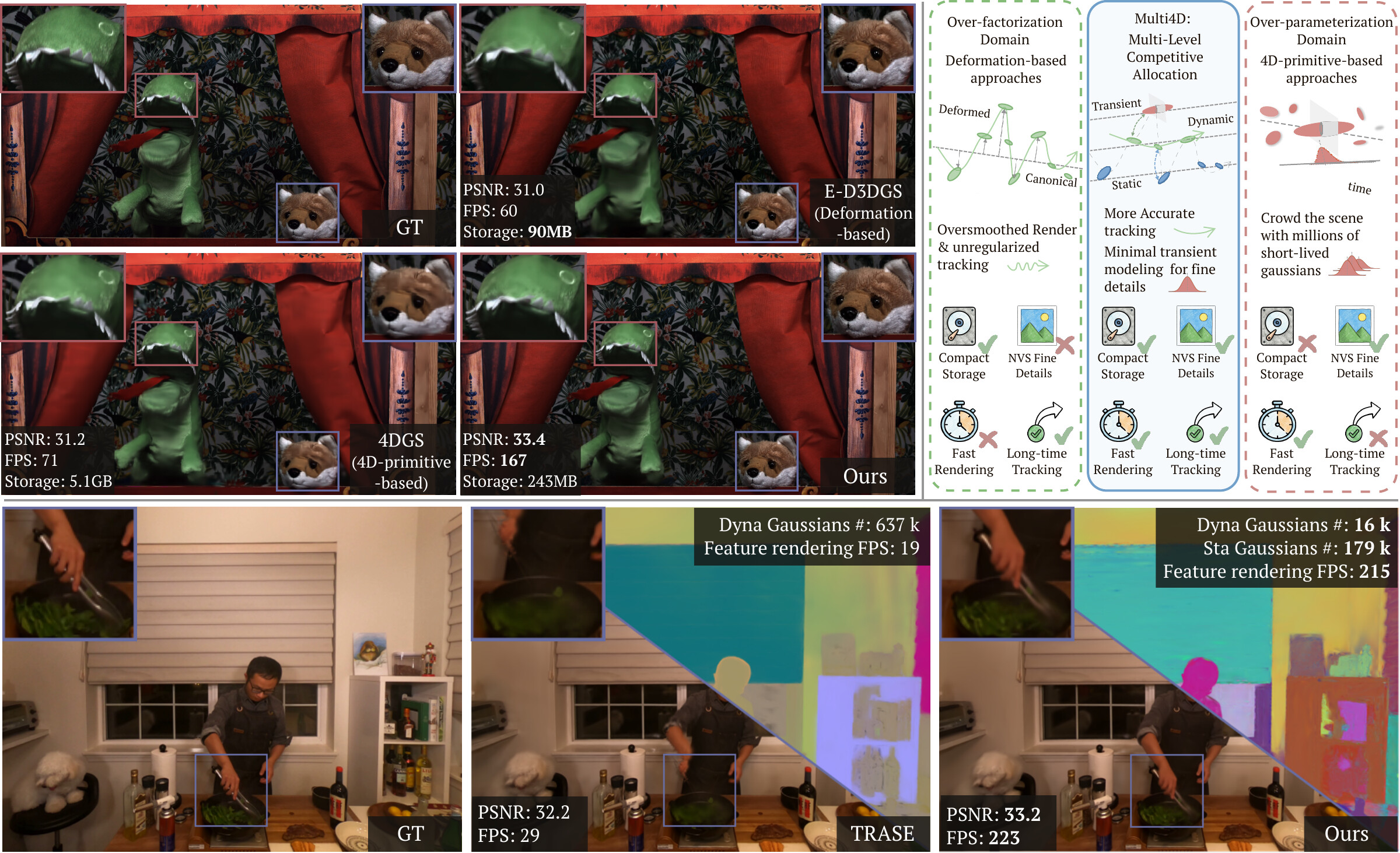
Multi4D enables high-quality, efficient dynamic scene reconstruction via competitive multi-level specialization, and compact, high-accuracy 4D segmentation with fast inference.Conference: Conference on Computer Vision and Pattern Recognition (CVPR 2026)
Authors:Malte Prinzler, Paulo Gotardo, Siyu Tang, Timo Bolkart
Given calibrated multi-view images of human heads, MATCH infers static Gaussian splat textures in dense semantic correspondence.Here’s what we've been up to recently.

We have seven papers accepted at CVPR 2024:RoHM: Robust Human Motion Reconstruction via Diffusion (oral presentation)EgoGen: An Egocentric Synthetic Data Generator (oral presentation)DNO: Optimizing Diffusion Noise Can Serve As Universal Motion PriorsMorphable Diffusion: 3D-Consistent Diffusion for...

We have five papers accepted at ICCV 2023:Dynamic Point Fields: Towards Efficient and Scalable Dynamic Surface Representations (oral presentation)EgoHMR: Probabilistic Human Mesh Recovery in 3D Scenes from Egocentric Views (oral presentation)GMD: Controllable Human Motion Synthesis via Guided...

